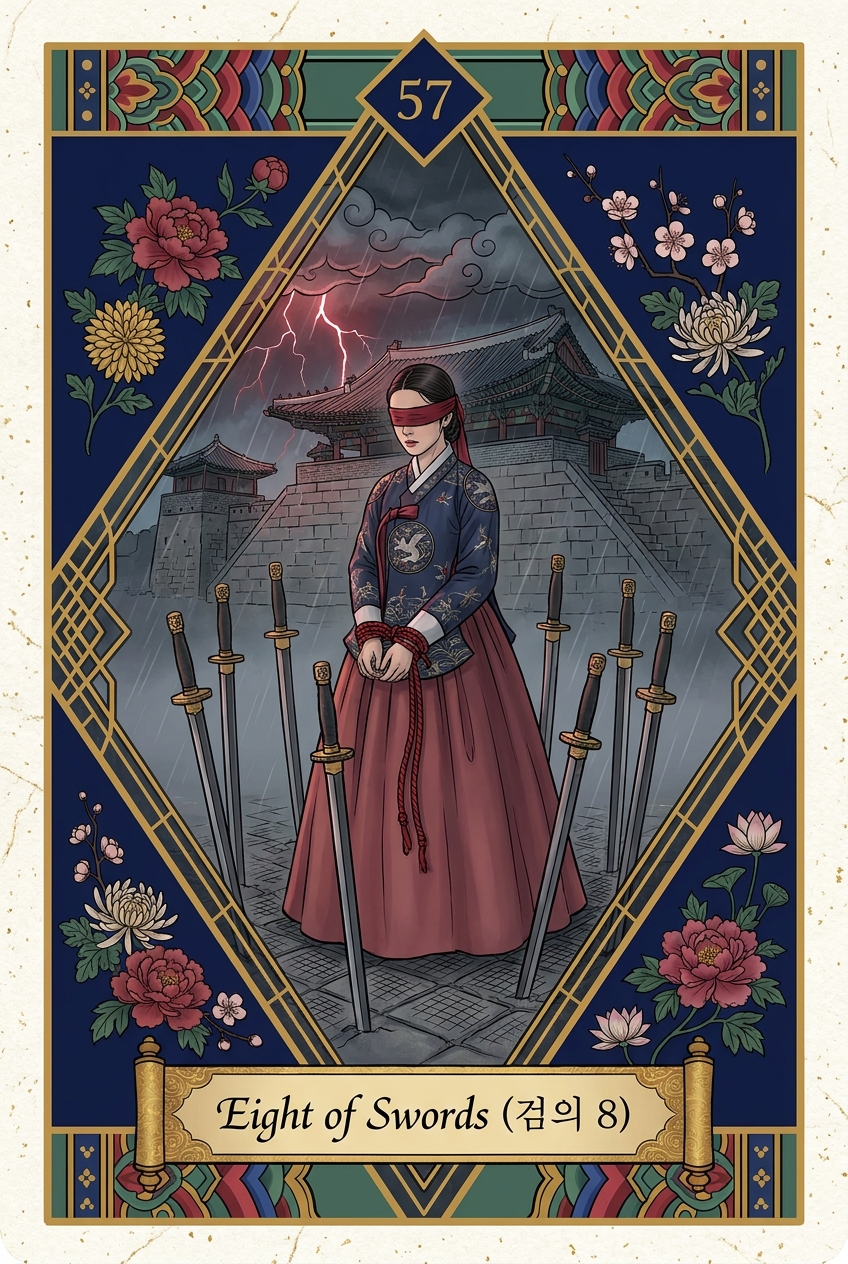
Eight of Swords
a powerless mind; loneliness; mental anguish
What the card means
The Eight of Swords is not about external imprisonment. The Joseon noblewoman stands blindfolded and loosely bound with red rope, circled by eight upright swords — but the restraints are slack enough to slip free if she moved. The card's whole point is that the cage is mostly made of her own refusal to try. Behind her, a fortress stands in storm. She has mistaken caution for captivity.
What matters here is the blindfold. She cannot see the space around her, cannot see that the swords form a circle rather than a wall, cannot see that escape is a matter of three steps in any direction. The card describes the moment when thought becomes a locked room — when you have rehearsed a single story about what is possible so many times that you no longer check whether it is still true.
Symbols in the art
- The blindfold
- She cannot see the gaps between the swords. The Eight of Swords is not about walls but about not looking — the mind refusing information that would change the calculation. This is self-imposed darkness, which makes it both more frustrating and more reversible than actual darkness.
- The loose red rope
- The binding is ornamental rather than functional. Red, in Korean tradition, often signals intention or will rather than accident. These are the restraints she has woven for herself, the rules she has internalized so completely that she no longer notices they are rules.
- The eight upright swords in a circle
- They form an enclosure, but not a prison — there are gaps. The swords are 金 — metal energy made visible. They represent boundaries, definitions, the edges that create shape. Here they create an illusion of enclosure rather than an actual one.
- The storm and the fortress
- Behind her stands a real threat — the fort suggests actual danger exists somewhere. But she is not in the fortress; she is outside it, in her own mind. The card separates the danger she fears from the one she has actually created.
Upright
You are more confined by what you believe than by what is actually true. The Eight of Swords arrives when a mind has circled the same calculation so many times that it stops checking for exits. Take the blindfold off — not metaphorically, but as a first action. Look at the actual situation rather than the story you have been telling about it. The ropes are looser than you think.
Reversed
Either the blindfold is coming off or you are pushing harder against bonds that will not break. Reversed, the card can read as dawning awareness — the moment you see that escape was possible all along. But it can also read as desperation, thrashing against a constraint you have misdiagnosed. Check whether you are actually trapped or whether you have simply decided to stay.
- In love
- Fear of commitment disguised as lack of choice. The other person cannot free you; only you can remove the blindfold.
- In work
- You have stopped trying because you have already decided it will not work. The constraint is real until you test it.
Through a saju lens
The Eight of Swords is 金 — metal: structure, definition, the mind making distinctions and building walls. For a 金 Day Master, this card often reads as self-recognition — you see how your own need for order has created a perimeter. For 木 — wood Day Masters, who move forward by instinct and tend not to second-guess themselves, the Eight of Swords appears as a warning about someone else's thinking, or as a moment when your usual momentum has been interrupted by overthinking. For 火 — fire, the card suggests passion has been extinguished by analysis. For 土 — earth, it points to worry habits that have hardened into walls. For 水 — water, the blindfold prevents you from feeling your way forward, which is usually water's strongest tool.
 Seven of Swords
 Nine of Swords
 Six of Swords
 Ten of Swords