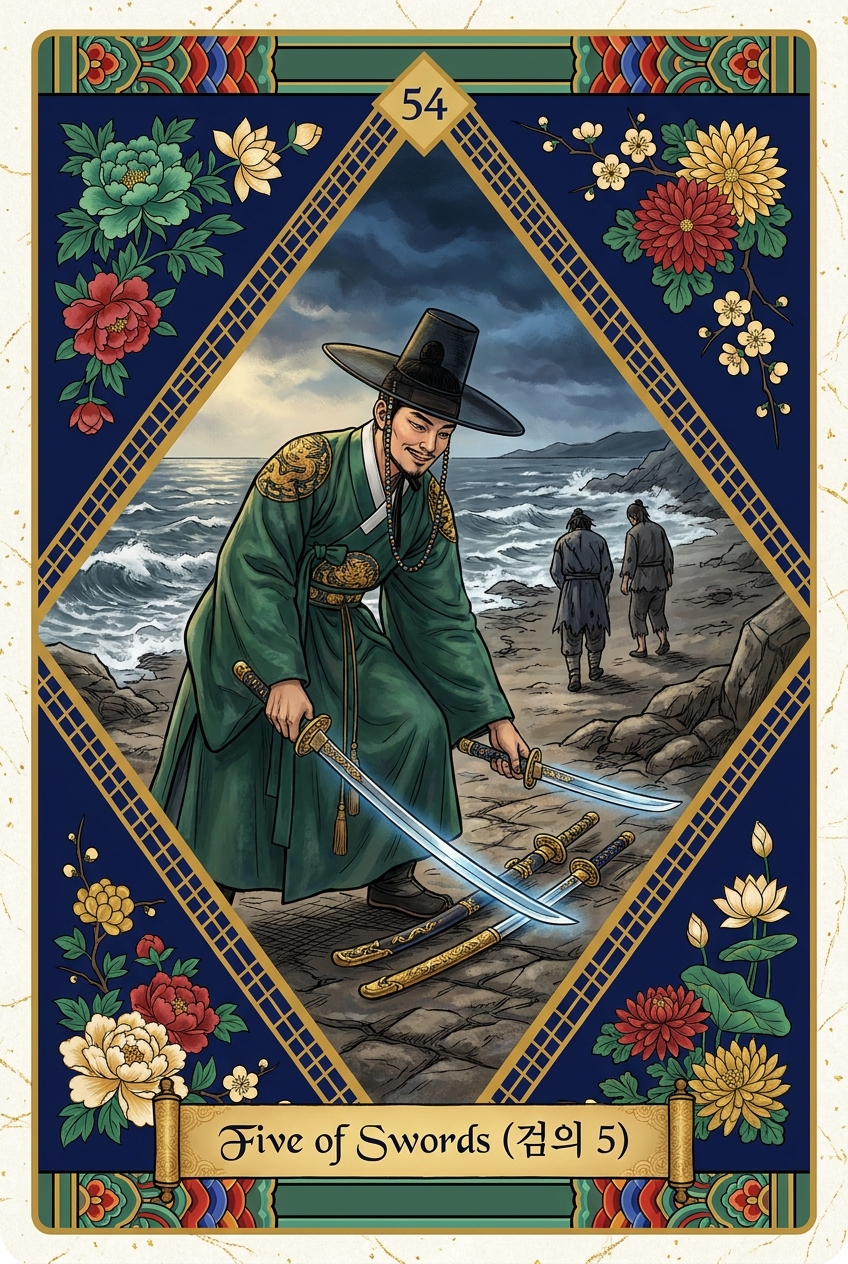
Five of Swords
a harmful desire; achieving your aim; a hollow possession
What the card means
This is the card of the pyrrhic outcome. The warrior has taken what he came for, and the field is littered with the proof: three swords gathered, opponents in retreat. But the grey sea and torn sky suggest that the ground beneath the victory has already begun to shift. What was won this way does not hold. The smirk on his face is not triumph — it is the expression of someone who has just realized that the prize tastes like nothing at all.
The Five of Swords describes the moment when you understand that achieving an aim by any means available has left you with the aim but not with what you actually wanted. It is not about failure. It is about success that costs more than it yields. The card asks: what did you keep, and what did you lose in order to keep it? The two figures walking away are not your enemies — they are what you left behind.
Symbols in the art
- The warrior's smirk
- Not satisfaction. The expression is already turning inward, toward the small cold knowledge that this victory is not what he thought it would be. The cost has become visible too late.
- Three swords gathered from the ground
- He has what he came for. But notice that they are all gathered in one grip — unstable, difficult to hold, impossible to use. This is what winning-at-all-costs looks like in practice.
- Two figures walking away in the distance
- They are not running in panic. The dejectedness is the card's true subject — these are the relationships, the principles, or the trust you surrendered in order to keep the swords.
- The choppy grey sea and storm-torn sky
- No solid ground. The landscape confirms what the expression already suggests: whatever you won here will not stay won. The instability is built in.
Upright
You have achieved something by methods you would not defend if asked to explain them. The victory is real but the foundation underneath it is already eroding. Pause before celebrating. The question now is not whether you won, but whether keeping this particular prize is worth what has been hollowed out in the winning. Sometimes the answer is yes — but not until you have actually counted the cost.
Reversed
The means have caught up with you before the end could justify them. Reversed, the Five of Swords often points to a scheme collapsing or a victory being taken back because the methods are now known. The other choice is to stop before you finish — to set the swords down and walk away, which is sometimes the only thing that still looks like winning.
- In love
- Someone won an argument and lost the relationship.
- In work
- You are getting what you asked for by burning capital you did not know you were spending.
Through a saju lens
金(metal) — the element of this card — is sharp, final, and leaves no ambiguity about boundaries. For a metal Day Master (庚, 辛), the Five of Swords often reads as a necessary correction: you have cut away what needed cutting, and yes, it looks harsh. The card reassures more than it warns. But for 火(fire) Day Masters (丙, 丁), who need reciprocity and witness, this card arrives as genuine cautionary weight — you are winning in a way that isolates. For 木(wood) Day Masters, the card points to expansion that has turned rigid and hostile. The remedy is different for each: metal restores through acceptance, fire through reconnection, wood through flexibility. 土(earth) reads it as a permanent rupture; 水(water) as an illusion of control about to shatter.
 Four of Swords
 Six of Swords
 Three of Swords
 Seven of Swords