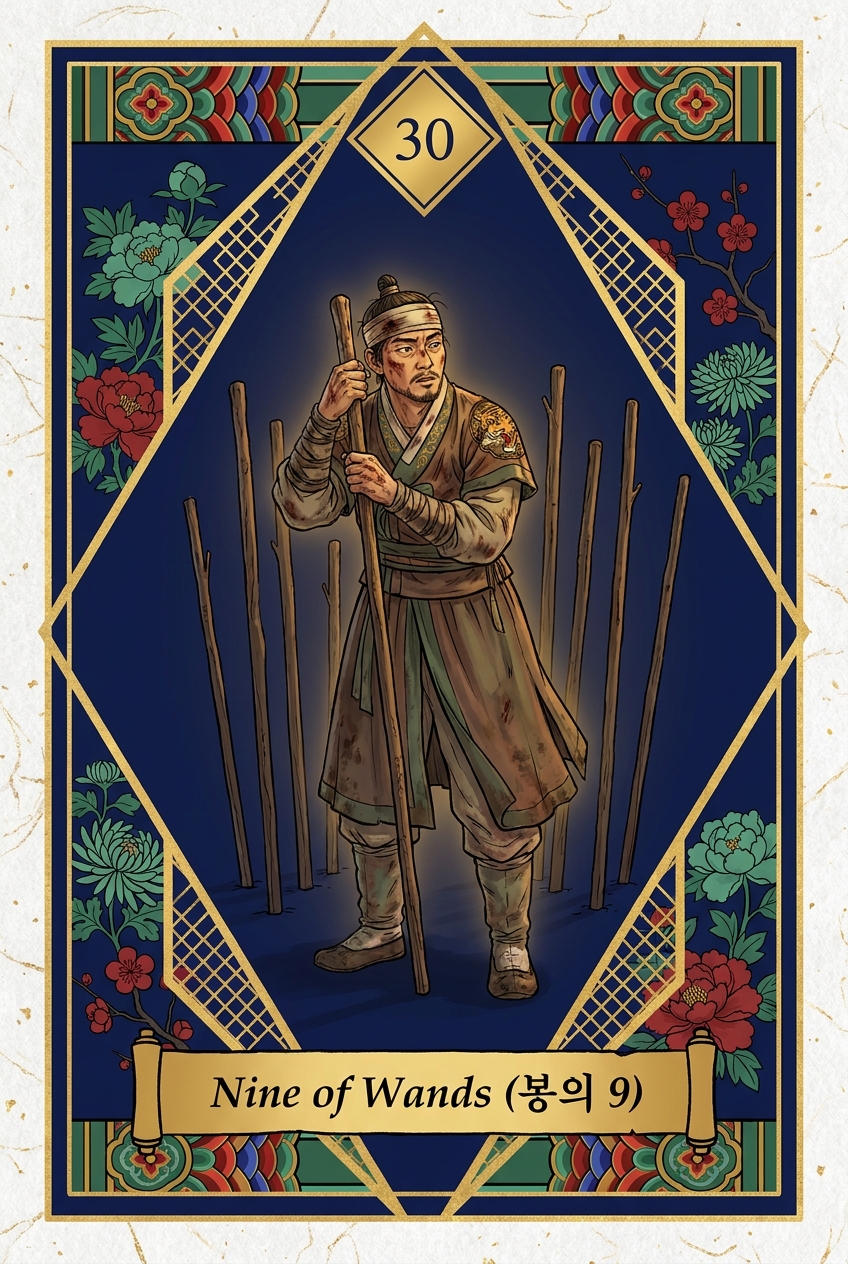
Nine of Wands
full preparation; time to regroup; a vigilant stance
What the card means
This is the card of someone who has already taken hits and is still here. The Nine of Wands does not promise that the next blow will not land — it only promises that you have learned how to absorb it without falling. The soldier in the KSaju deck is bandaged and weary, but his eyes are scanning the horizon. He has stopped asking whether he should fight; now he is asking what form the fight will take, and whether he can meet it without breaking his own stance.
What makes this card different from simple endurance is that the stance itself is a choice. Eight staffs form a fence behind him — preparation, boundary, a visible line that says: this is how far I will let you come. He is not hoping to survive the next thing. He is braced for it. That distinction matters. The card appears when you have moved from panic to readiness, from fear of what might happen to preparation for what probably will.
Symbols in the art
- Bandaged head and visible wounds
- He is not pretending the earlier battles did not happen. The injuries are visible and recent. This is not a card about invulnerability but about continuing anyway — about the specific strength that comes from being wounded and still standing.
- One staff, leaned on
- He carries his own weight on a single wand. It is both anchor and weapon, grounding and reach. The one staff he holds is the only one he controls; the eight behind him form the perimeter.
- Eight staffs forming a fence
- The defensive line behind him is built, completed, and held. This is preparation made visible — the work done in advance so that when the next test arrives, you do not have to improvise a defense.
- Alert, watchful eyes
- His gaze is fixed outward, scanning. He is not relaxed, but he is not panicked either. This is the calm attention of someone who has decided what he will do when the challenge arrives.
Upright
You have prepared. The next thing is coming and you have already thought through how you will meet it. Do not second-guess the work you have done in advance — the eight staffs are in place, your stance is set, your eyes are on what is actually happening rather than on catastrophe. Hold this position. Vigilance is not paranoia when the challenge is real.
Reversed
The fence is broken or you are exhausted behind it. Either you are defending a position that has already been compromised, or you have been braced for so long that the posture itself has become the injury. Step back. Sometimes the best defense is not to stand and hold but to retreat and regroup.
- In love
- You are guarding something — either your own boundaries or a relationship that feels like it needs defending.
- In work
- You have done your homework. Now hold your ground and let the other person reveal what they actually want.
Through a saju lens
火 (fire) fuels the Nine of Wands — the will to stand, to fight if necessary, to refuse the easy collapse. A 화 (fire) Day Master reads this card as a warning that vigilance can harden into paranoia; your natural intensity is already there, so the card asks whether you are braced *for* something or *against* something. A 수 (water) Day Master often finds this card appears as permission — to stop being fluid, to form an edge, to say no. A 목 (wood) Day Master may feel the tension: the impulse to keep expanding conflicts with the need to hold the line. 토 (earth) and 금 (metal) Day Masters read this card more straightforwardly — preparation suits them — but earth often reads it as exhaustion and metal as excessive rigidity.
 Eight of Wands
 Ten of Wands
 Seven of Wands
 Page of Wands