Six of Swords
breaking free; a turning situation; moving on
What the card means
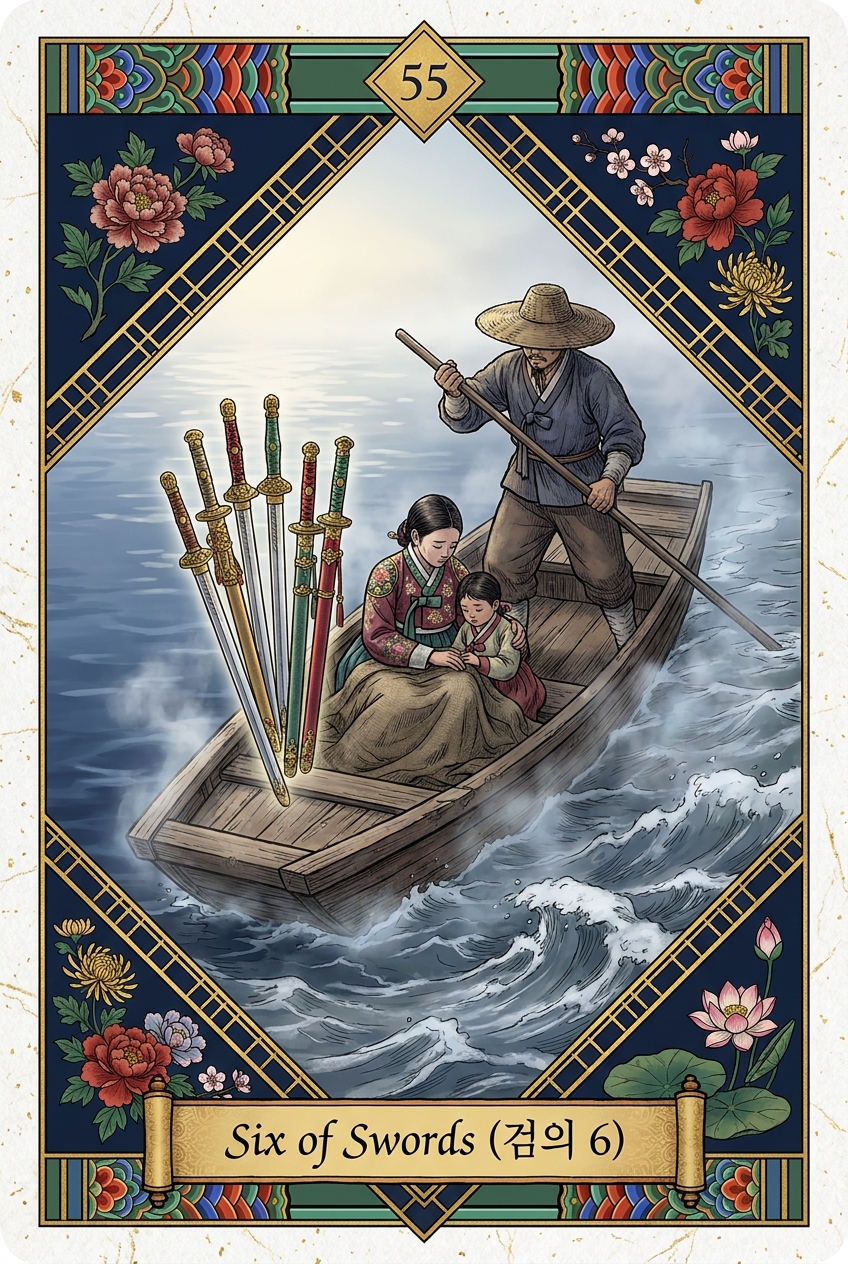
The Six of Swords is motion with weight. A ferryman poles a wooden boat across a river, a woman and child huddled in the bow, six swords planted upright in the prow like a fence or a ward. The waters behind are rough and choppy; ahead they smooth into grey-blue calm. This is not escape as flight — there is no panic here, only steady work. The passage takes time. Someone is doing the labour of moving you from one state to another.
The card describes a turning situation where the direction is already established but the arrival is not immediate. You are leaving trouble behind, yes, but you cannot skip the crossing. The mist suggests you cannot see far ahead either. What matters is that the current is running toward shelter, and that someone knows how to read the water well enough to pole through it. This is the card of the situation that is already improving, even though improvement still has distance to cover.
Symbols in the art
- The ferryman poling steadily
- He is not rowing frantically or fighting the current. His work is methodical and competent — the kind of labour that moves you because it knows the river. The passage itself is the point. Without the ferryman's skill, the destination would not matter.
- Six upright swords in the prow
- Metal swords planted like sentinels, standing between the passengers and the rough water. They are not drawn or raised — they are rooted, forming a barrier or a boundary. Protection through structure and firmness, not through aggression.
- Woman and child huddled in the bow
- They are the cargo, the reason for the crossing. They are not steering or working. Their job is to stay put and trust the ferryman's knowledge. Vulnerability is allowed here because passage is being managed by someone steady.
- Rough water becoming calm
- The transition from choppy to smooth marks the arc of the card — not a sudden shift but a gradient, a slow settling. The muted grey-blue and pale morning light suggest emergence from something darker into something gentler, though not yet bright.
Upright
You are moving away from turbulence, but the crossing itself still requires patience and steady work. This is not the card of escape — it is the card of managed passage. Trust the ferryman, whoever or whatever that is: the process, the person helping, the plan that is already in motion. Stay low and let the current carry you. The swords are there; the direction is set. What you cannot do yet is see the far shore clearly, and that is fine.
Reversed
The crossing is stalling or the direction is uncertain. Either the ferryman has lost his way in the mist, or the passengers are fighting the boat's motion, or the swords that were meant to protect are now keeping something trapped. The water may be growing rough again. Check whether you are actually moving or whether you have stopped midstream.
- In love
- A relationship in transition — moving from one state toward another, with both people understanding they are in the crossing, not yet at the destination.
- In work
- A project or role in managed transition. You are being moved toward a better position by something external; your job is to keep steady during the passage.
Through a saju lens
The Six of Swords is 金 (metal) — swords are metal, the structure is metal, the boundary holds. Metal is about definition, containment, moving from disorder into form. For a metal Day Master — 庚(geng) or 辛(sin) — this card reads as natural: you understand the logic of protective barriers and steady method. For 木 (wood) Day Masters, the six upright swords can feel restrictive, like being caged in order to be saved; the crossing works, but it costs you motion and flexibility. For 火 (fire), the muted grey-blue light and the passive waiting read as dimming; for 水 (water), the ferryman's competence and the clear direction feel like shelter. For 土 (earth), the steady passage and the defined endpoint offer grounding.
 Five of Swords
 Seven of Swords
 Four of Swords
 Eight of Swords