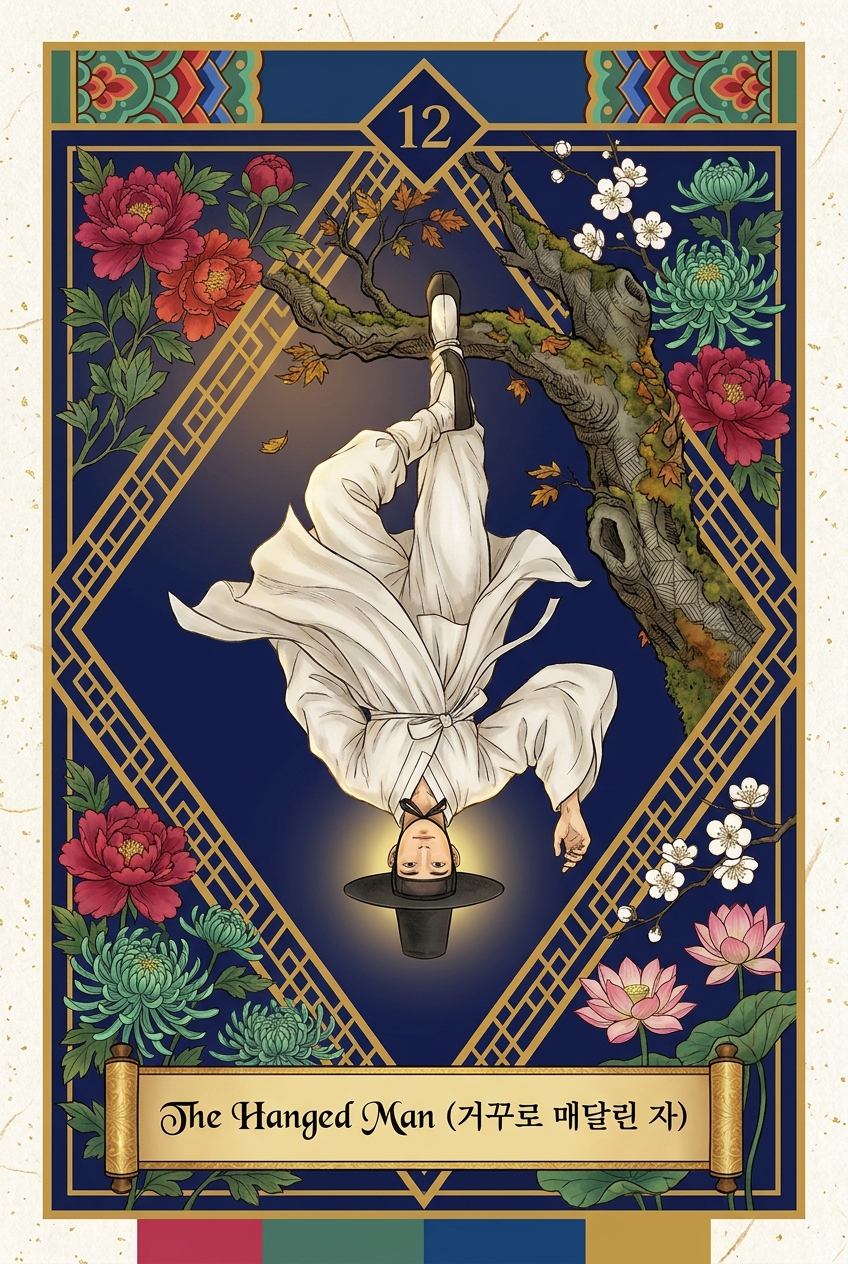
The Hanged Man
an isolating pause; a shift in perspective; patience and realization
What the card means
The Hanged Man is not suffering. He hangs by one ankle from a zelkova branch in an old Joseon garden, his white robes falling toward earth, his face ringed in golden light, his expression calm as a scholar in meditation. He has stopped moving not because he was forced to, but because he chose to flip the world upside down and look at it from below. The card asks what you see when you are willing to be still enough, long enough, to let your perspective crack open.
Confinement in this card is voluntary — it is the price of insight. The halo suggests enlightenment that arrives through constraint rather than through motion. When the Hanged Man appears, something has already paused: a relationship, a plan, a way of thinking you have carried so long you forgot it was a choice. The card does not ask whether you want this interruption. It asks what becomes visible now that you have stopped pretending the old angle was the only angle.
Symbols in the art
- Hanging by one ankle from the zelkova branch
- The tree is ancient, rooted, patient. Hanging is deliberate, not accidental — this is suspension by choice, not punishment. One ankle does the work of holding; the rest of the body is free to reorient. The posture itself is the meditation.
- White hemp robes flowing downward
- Joseon scholar's dress, simple and undyed, now flowing the wrong direction — toward the earth instead of away from it. The fabric moves in the direction of gravity, emphasizing that perspective has literally inverted. What hangs down is now what matters.
- The halo of soft golden light
- Not divine intervention but the glow of understanding. The light circles his face from below, the new bottom, suggesting that clarity arrives from the inverted angle, not from the world as it was arranged before.
- Moss and autumn leaves on the tree
- Time has accumulated here. The tree is not young, and the season is late. This is a pause that happens after something has lived long enough to need revision, not before it has begun.
Upright
You are in a voluntary pause — you have chosen to stop moving in order to see differently. The world has not changed, but your vantage point has. Use this interruption for what it actually is: a chance to examine the assumptions you forgot were assumptions. Patience here is not passive. It is the work of holding still while understanding rewires itself. The card suggests that the insight worth having requires you to be suspended, at least for now.
Reversed
The pause has become involuntary, or it is being resisted. Reversed, the Hanged Man points either to confinement that has curdled into resentment, or to someone who refuses to stop long enough to let their perspective shift. The pause may still be necessary. The refusal to accept it is the problem.
- In love
- A necessary step back to see the relationship clearly, or a stall that has grown uncomfortable.
- In work
- A project halted for reassessment, or a role that requires you to work in a way that feels unfamiliar and upside-down.
Through a saju lens
The Hanged Man connects to 水 — water: the yielding element that takes the shape of whatever holds it, that flows downward, that reflects and clarifies. Water Day Masters (壬, 癸) often read this card as describing how they naturally work: fluid, adaptive, willing to approach from underneath. For 火 — fire Day Masters (丙, 丁), whose nature is to rise and illuminate directly, the Hanged Man arrives as foreign instruction: the card is teaching them what happens when you stop burning for a moment and let coolness in. 木 expansion resists it; 金 structure finds it useful if temporary; 土 stability can hold the pause, but becomes restless inside it.
 Justice
 Death
Death Wheel of Fortune
 Temperance