The Hierophant
true guidance; inner peace; firm trust
What the card means
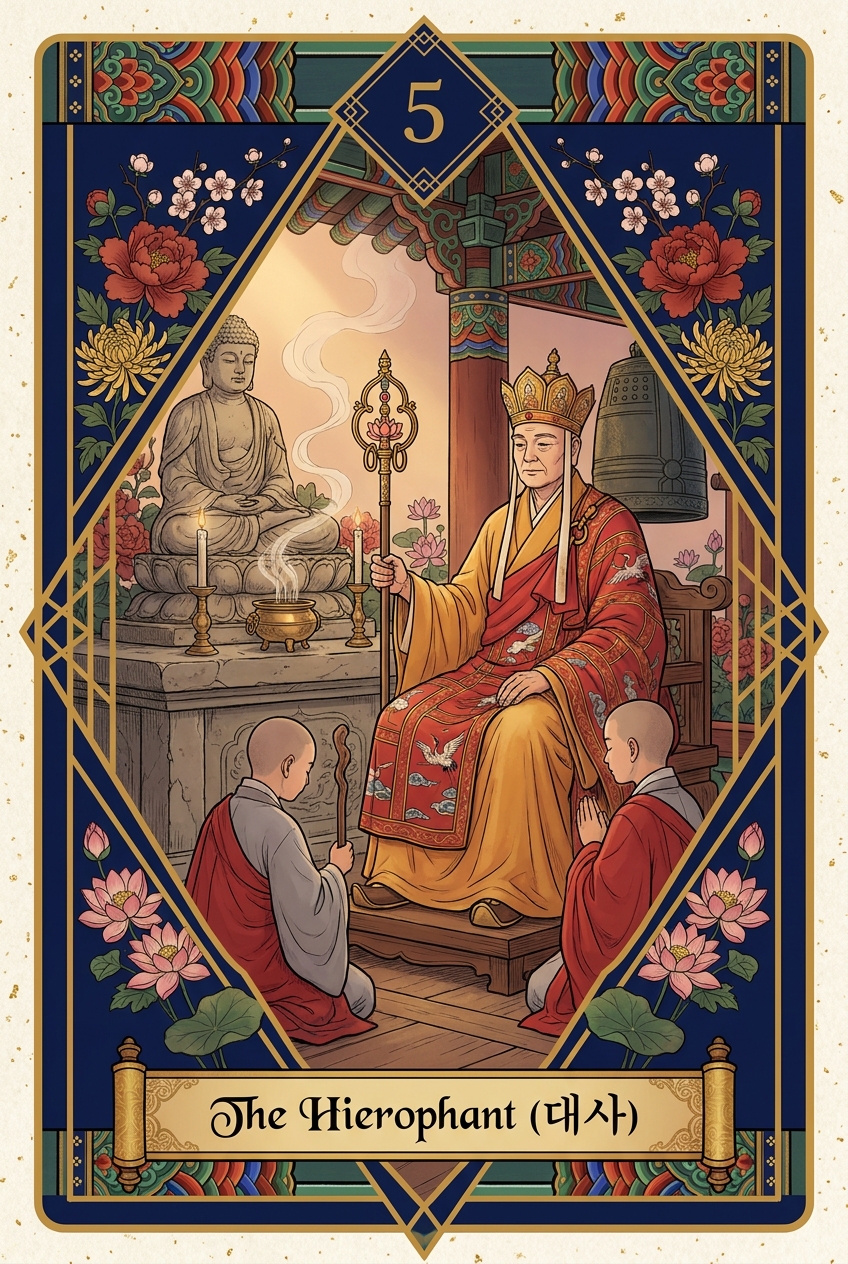
The Hierophant sits between two temple pillars in the full weight of his office: saffron and crimson robes, a lotus staff, young monks at his feet. He is not the knowledge itself but the person who has become a conduit for it—trustworthy because he has already been broken by the work of holding it. The card describes the moment when learning stops being accumulation and becomes transmission.
What he offers is not inspiration but grounding. The incense smoke curls upward but he remains seated, rooted. When this card appears it is often asking whether you are ready to stop searching and start listening—not to abandon your own discernment, but to recognize that some doors require a guide who has already walked through them. The stone Buddha altar behind him suggests that his authority comes from something older than himself.
Symbols in the art
- The lotus staff
- Held steady in his hand, it marks him as a teacher of the dharma—not a symbol of power seized but of responsibility accepted. The lotus grows from mud into light, which is exactly what a true guide helps you do.
- Two young monks kneeling
- Their devotion is not blind. They have chosen to study with him because his years of practice have made him readable—trustworthy in the way a stone is trustworthy, weathered by its own experience into reliability.
- Stone Buddha altar and dancheong pillars
- Both represent tradition that has held its shape across centuries. He sits within something larger than himself, which is precisely what gives his guidance weight. He is not inventing wisdom but stewarding it.
- Incense smoke curling upward
- The bridge between earth and heaven, visible but immaterial. His teaching works the same way—it cannot be grasped directly, only breathed in and allowed to settle into the body over time.
Upright
A guide has appeared or it is time to become one. The Hierophant upright is about choosing to trust someone whose experience you can verify, or about stepping into the role of teacher because you have finally paid enough dues to speak without qualification. This is not about blind faith—it is about recognizing when someone has genuinely walked the path before you. Ask for help. Give it if you are asked.
Reversed
The guide has become an institution, or the student has stopped thinking for themselves. Reversed, the Hierophant points to authority claimed without earned weight behind it, or to wisdom that has calcified into dogma. Check whether you are following someone's teaching or someone's image.
- In love
- A partnership grounded in shared values and genuine trust rather than infatuation.
- In work
- Find a mentor or mentor someone. The knowledge you have is not valuable until it moves to the next person.
Through a saju lens
The Hierophant carries 土 — earth energy: stability, tradition, the accumulated weight of generations. Someone with a 土 Day Master often reads this card as recognition—you are already building toward this role of trusted guide, and the card is simply naming it. For 火 Day Masters, who burn bright and fast, the Hierophant can feel constraining; the reading then asks whether you are willing to slow down enough for others to follow. 木 sees it as permission to put down roots. 金 respects the structure but may resist the vulnerability of admitting you need guidance. 水 recognizes that the Hierophant too is shaped by what he contains; his teachings, like water, take the form of the vessel.
 The Emperor
 The Lovers
 The Empress
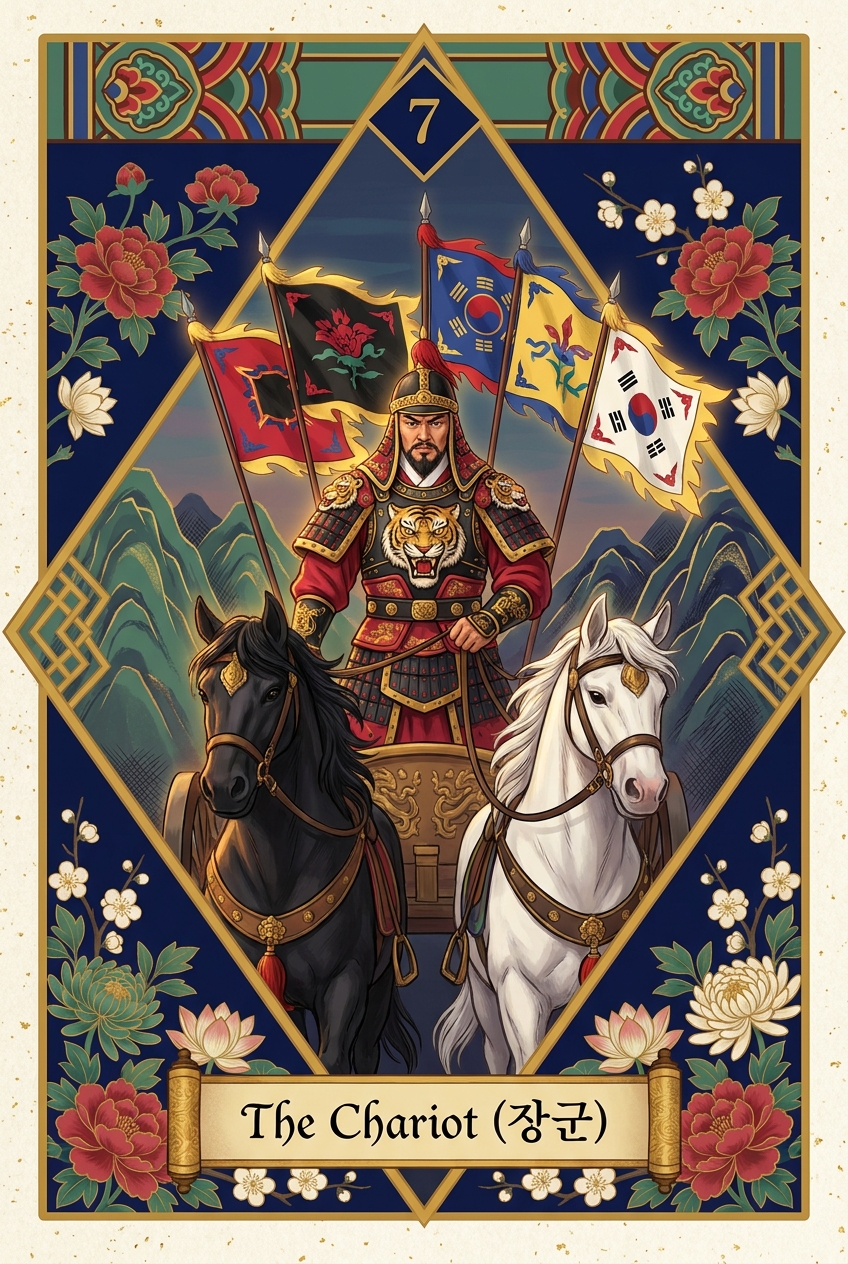 The Chariot