The World
reward for your efforts; harmonious effort; ultimate fulfillment
What the card means
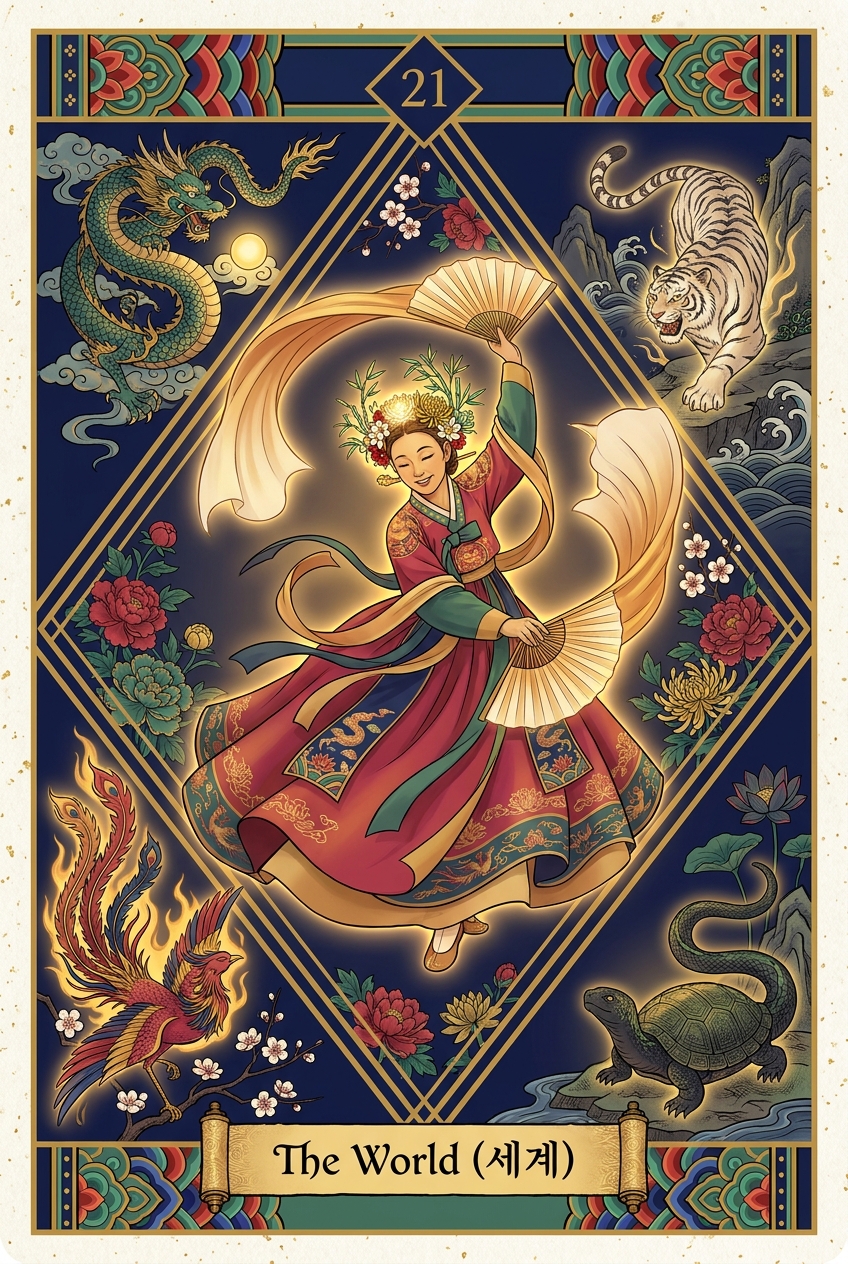
The World is what happens when all the work stops being work. A figure dances inside a wreath of the four noble plants — plum, orchid, chrysanthemum, bamboo — each one planted in restraint, each one flowering anyway. The four guardian deities watch from the corners: dragon, tiger, phoenix, tortoise. This is not rest after effort. This is effort and rest the same thing. The card says: you have moved through all twenty predecessors and arrived somewhere that contains all of them.
The five-color robe she wears holds all five elements in one garment. The two silk fans she moves are not fighting the air — they are dancing with it. When the World appears it usually means a cycle has genuinely finished, a project has found its shape, a version of yourself has completed its reason for existing. What comes next is not promised. But this: this part is done, and done well enough that you can feel it.
Symbols in the art
- The dancing figure
- Her body is in motion but her stance is rooted. This is not the Fool's weightless step but a grounded turn — the difference between beginning and arriving. The dance itself is the completion, not a means toward something else.
- The wreath of four noble plants
- Plum, orchid, chrysanthemum, bamboo are the scholar's four gentlemen in Korean painting — restraint made visible. The wreath contains all of them at once, which is what harmony actually looks like: not each one taking turns, but all four blooming in the same frame.
- The four guardian deities at four corners
- Azure dragon, white tiger, red phoenix, black tortoise mark the cardinal directions and complete the cosmic circle. They are not defending her; they are witnessing. She dances inside their attention.
- The five-color robe and two silk fans
- Obangbaek — the five colours — contains wood, fire, earth, metal, water woven into one cloth. The fans are not weapons or shields but instruments of motion, making the air into something visible.
Upright
This is the card of the closed circle. Something you began has ripened. A version of your effort has reached its natural end, and the ending itself is the proof it was worth doing. Do not mistake this for permission to stop moving — the World is not laziness — but do let yourself feel the shape you have made. You have earned the moment where the cost and the reward balance exactly. Enjoy it before the next beginning.
Reversed
The circle has not closed. Either you are still pushing at something that should have finished, or you left before the work was done and now feel the incompleteness like a weight. The card reversed asks: what are you refusing to let end, and what did you abandon before it was ready? One is as damaging as the other.
- In love
- A relationship that has moved through seasons and arrived somewhere both of you recognise as home.
- In work
- A project that has found its final shape. Completion is here, even if you are not yet ready to call it that.
Through a saju lens
The World holds all five elements in balance — 목火土金水 dancing together. For a 목 (wood) Day Master, this card often reads as a natural endpoint of a growth cycle, permission to rest before the next expansion. Fire 일간 sees it as recognition earned, the moment when effort transmutes into respect. Earth Day Masters recognise themselves in the stability: the foundation has held. Metal 일간 reads it as form completed, the design now finished — though metal often feels the pull to refine it one more time. Water Day Masters, whose nature is flux, sometimes struggle with closure; the World asks them to hold still long enough to see what the stillness reveals. The card's real message shifts by element: for wood it is 'you grew'; for fire, 'you shone'; for earth, 'you held'; for metal, 'you built'; for water, 'you flowed into shape.'
 Judgement
 The Fool
 The Sun
 The Magician