Three of Pentacles
a chance to cooperate; excellent skill; proven competence
What the card means
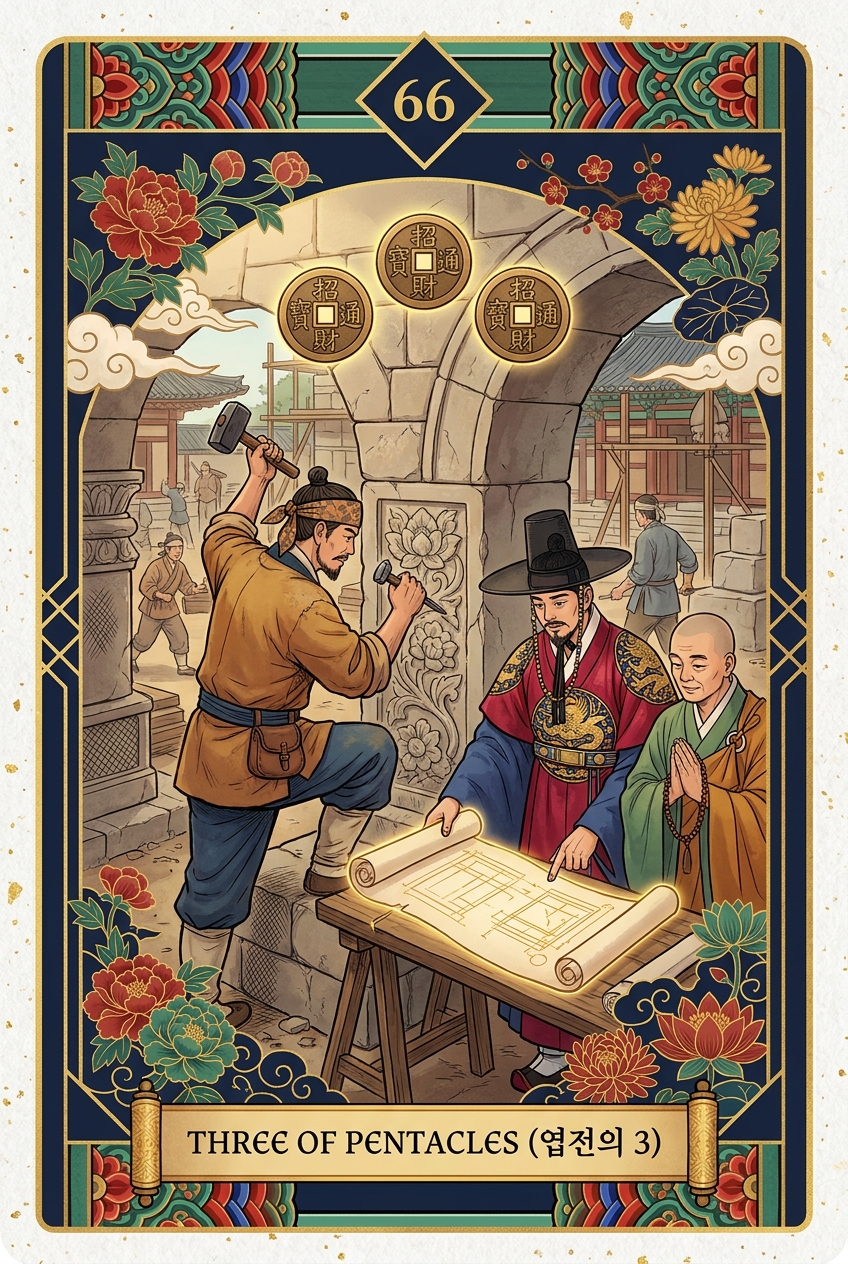
The Three of Pentacles is where effort stops being private and becomes visible. A craftsman consults blueprints with a nobleman and a monk — the work is no longer solitary, and it is no longer theoretical. Three yeopjeon are carved into the stone arch above them: the tangible proof that hands and knowledge have produced something real. This is the card of the moment when you are no longer proving yourself in isolation. Someone is watching. Someone approves.
What matters here is not the idea but the execution. The scroll exists, yes, but the stone has already been shaped. The three figures are oriented toward the work itself, not toward each other — cooperation in this card is directed outward, toward the object that requires all of them. This is what distinguishes it from the easier collaborations: no one is here because they like each other. They are here because the task is difficult enough to require more than one kind of expertise.
Symbols in the art
- The craftsman with chisel
- His hands are the centre of the image. The work is not an idea he is explaining or a theory he is presenting — it is stone being actively shaped by skill applied in the present tense. Expertise is being performed, not discussed.
- The scroll of blueprints
- The plan exists, but it is consulted, not followed blindly. The craftsman is not executing orders handed down from above — he is in conversation with the design, showing how it translates into the actual stone in front of him.
- The three yeopjeon carved into the arch
- Three coins, three people, three kinds of authority: the worker, the patron, the institution. The coins are not payment yet — they are the structure holding everything in place. Competence has been recognized and is now embedded in the work itself.
- Warm stone ochre and deep blue robes
- The colours ground the scene in real material. This is not a metaphorical collaboration happening in the clouds. The stone is solid, the robes are heavy fabric. The work is tangible and so is the recognition.
Upright
Your competence has been noticed and is now being asked to prove itself in a larger context. This is not the card of the lone genius — it is the card of the skilled person whose skills are now genuinely needed. Show up, listen to what the work is actually asking, and do not mistake collaboration for consensus. You are here because you know something the others do not. Trust that knowledge.
Reversed
The collaboration is deteriorating into politics, or your skill is being borrowed to cover someone else's mistakes. Reversed, this card often points to being brought in too late to do the work properly, or to being asked to validate something already decided. Step back and check whether you are being consulted or being used.
- In love
- Mutual recognition — attraction is not enough here; there needs to be something you both respect about how the other works.
- In work
- Your competence is now on display and is being rewarded. Do not apologize for the skill that got you here.
Through a saju lens
Three of Pentacles reads through the lens of 土(earth) — the element of form, of work made manifest, of potential becoming real. For a 일간 whose foundation is 土 — earth stems like 戊(wu-earth) or 己(ji-earth) — this card often arrives as validation of what you have been building all along. The recognition fits naturally. But for a 水(water) Day Master, whose element dissolves fixed form, this card can feel constraining: the collaborators want commitment and clearly-defined roles, while your nature is to remain fluid. For 金(metal) — which prizes perfection and completion — the card reads as the work being good enough to show, but perhaps not finished enough to satisfy. For 火(fire), it is about ego being directed toward the task rather than toward status. For 木(wood), it is about expansion being held in a structure that gives it meaning.
 Two of Pentacles
 Four of Pentacles
 Ace of Pentacles
 Five of Pentacles